
How Sandisk Built the World's Smallest 1TB USB-C Drive
Some tech products lead their category; others establish a category of their own. The SANDISK® Extreme Fit USB-C™ flash drive manages to do both. The tiny, plug-and-stay drive was crowned the world's smallest* 1TB1 USB-C flash drive. It has quickly become a permanent fixture for anyone yearning for more storage in a format so discreet, you'll forget it's there.
"Making something 'simple' is never easy," says Sumukh Ontimitta, Senior Engineer, Packaging Engineering at Sandisk, whose team proposed this idea in 2018. That principle would guide engineers across mechanical, hardware, packaging, and industrial design to build the impossibly tiny 1TB1 drive.
Building the smallest
The tech world has gone all-in on USB-C. The tiny connector's form factor has fostered slimmer laptops, faster speeds, and universal compatibility with everything from notebooks to smartphones.
For Sandisk, the shift has meant taking its popular plug-and-stay category into a new era. But that transition was a monumental challenge, according to Sridhar Nara, Director of Consumer Product Management at Sandisk.
"With USB-A, the connector was large enough so that we could neatly tuck the memory technology within the connector itself," Nara said. "However, USB-C connectors are an entirely different beast—they are so small, it forces the memory outside the connector."
Once the memory moves outside the port, durability becomes an existential challenge. How do you prevent a tiny drive from snapping off or losing electrical integrity in everyday use?
The answer, explained Nara, was less about the chase to shrink components and more about rethinking how to piece them together.

A vertical edge
USB sticks, memory cards, external drives—almost every USB accessory connects using horizontal alignment, where two thin, flat surfaces meet in parallel. An entire ecosystem grew around this convention.
But if you want a tiny drive to stay connected to your laptop while on the move, having something protrude from the USB port is a disaster waiting to happen.
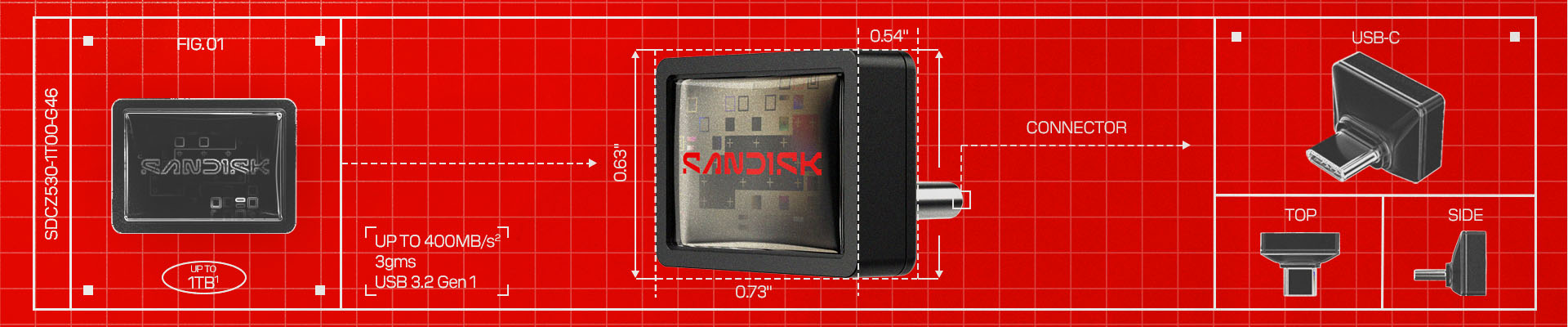
The team's first breakthrough was to flip the convention and mount the USB-C connector perpendicular to the System-in-Package (SiP), the brains of the device.
With no existing solution on the market, engineers devised a clever workaround using a tiny interposer Printed Circuit Board (PCB). The miniature PCB interface could route signals between the connector and the SIP while also reinforcing the extremely small and fragile vertical connection.
"This is the smallest SiP we have and the first time we created a vertical type C connector ever," said Deepesh Singh, Principal Engineer of Systems Design Engineering at Sandisk, who served as the product development team lead.
The challenge, he explained, proved greater than they imagined. A perpendicular connection is a little like balancing a piece of chalk on its end—maintaining reliable contact is hard. The joint must withstand shock, vibration, and thousands of insertions without microcracking or creep deformation.
"We built several prototypes, but they kept breaking," Singh recalls. "But there was an appetite for risk, a trust in the team, and we had the confidence to keep pushing."
Making it stick
Bridging the gap between an industrial design concept and a production-ready mechanical CAD model introduced an entirely new layer of complexity.
Productization demanded extensive multi-structural and thermal simulations. It required detailed engineering calculations, new process innovations, and iterative prototype builds. With each cycle, teams would refine performance, improve manufacturability, and push for long-term robustness.
But as the form factor continued to shrink, reliability quickly became the dominant challenge. Even minor vibration could translate into significant stress on the SiP. The teams needed a way to lock the structure securely in place.
"We started experimenting with epoxy injection to bond the inner assembly to the lid set," said Vinay Kamagoud, Mechanical Design Engineering Manager at Sandisk. "But getting from something that works once to something that works a million times requires a mass-production mindset."
Epoxy begins as a semi-liquid and cures over time. Without precise flow control, down to fractions of a millimeter, it can seep into sensitive components and compromise both yield and reliability. To prevent that, the team had to develop new tooling, adopt tight process control, and let simulations guide their decisions.
"Making this the smallest form factor yet introduced significant challenges in achieving both strength and thermal stack-up," Kamagoud said. "It ultimately came down to choosing the right materials."
Those material choices influenced every aspect of the design—from enclosure strategy and control of electromagnetic and electrostatic interference to heat dissipation and structural rigidity.
To bring everything together, the team turned to ultrasonic welding. The method didn't just maintain the compact footprint; it also created a clean, seamless exterior while providing the mechanical strength at scale. In the end, it struck the perfect balance between aesthetics, reliability, and manufacturability.

An iconic design
There's a kind of magic when a product feels effortless, and the SANDISK Extreme Fit USB-C drive aimed squarely for that feeling. Behind the scenes, though, that effortlessness is the result of painstaking design and rigorous groundwork.
Using 3D-printed prototypes, the team tested the connector on hundreds of different laptops to pinpoint the ideal offset. No matter the brand or model, the drive needed to remain unobtrusive, never tilting the laptop or acting like a kickstand.
The team also pushed capacity and performance to 1TB1 and 400 MB/s2. The drive should be tiny in size but not in capability. And ultimately, it was the team's insistence on pushing the device's visual design that made the Extreme Fit distinct.
"This was one of the hardest products I had to design," said Adrian Karaan, Industrial Designer at Sandisk, who designed the drive's artwork. "It was such a small sandbox I could play with—how do I make something so tiny unique? How can I make it stand out?"
Karaan's research led him back to the heart of Flash storage: silicon. He began mapping the atom, rings, and electrons, slowly refining his sketches into something conceptual.
"At first glance, people don't quite know what they're looking at—it's intentionally abstract," Karran said. "But once they look closer, they can see the visualization of the atom, and I love how it connects back to the technology inside."
By carving a small window into the enclosure and capping it with a thin, rounded lens, the team could create a striking effect. As light moves across the surface, the iridescent artwork appears to shift, with some users even mistaking it for a small display.
"That's exactly the effect we wanted," Karaan said.
Making what's next
The SANDISK Extreme Fit USB-C drive is the product of hundreds of contributors across packaging, mechanical, systems, hardware, and industrial design—a simple object built through complex collaboration.
For Sumukh Ontimitta, that philosophy of simplicity has come a full circle with the launch.
"Simplicity was a guiding philosophy for the team and the product journey," he said. "Every decision, every constraint, multiple patent filings, and every late-night discussion. We had to get our basics right, we had to do all the brainstorming in advance for potential issues, and special kudos to the factory as well. They didn't deviate."
Now, holding the tiny device in his hand, he can finally celebrate that purposeful design.
"It's not over-engineered," he said. "There is nothing extra that the user doesn't want. It's storage without the fuss."
That restraint resonated.
According to Sridhar Nara, early user feedback has been overwhelmingly positive. Sandisk's channel partners are enthusiastic, and companies are already reaching out to explore pairing the SANDISK Extreme Fit USB-C drive with their own products.
"We wanted to make a product people love," Nara said, "and people loved that Sandisk was able to innovate."
Disclosures
- * Based on dimensions as of February 4, 2026.
- 1. 1 GB = 1,000,000,000 bytes. 1 TB = 1,000,000,000,000 bytes. Actual user storage may be less.
- 2. Based on read speed, unless otherwise stated. 1 MB/s = 1 million bytes per second. Based on internal testing; performance may vary depending upon host device, usage conditions, drive capacity, and other factors. USB 3.2 port required.
Author
Ronni Shendar
February 26, 2026
[7 min read]